


Global Franchise Frontiers
Five franchise experts from Thailand, the Philippines, Singapore, Indonesia and Malaysia shared one stage at FLEI 2026. Their message: a brand that wins at home cannot simply be copied and pasted abroad.
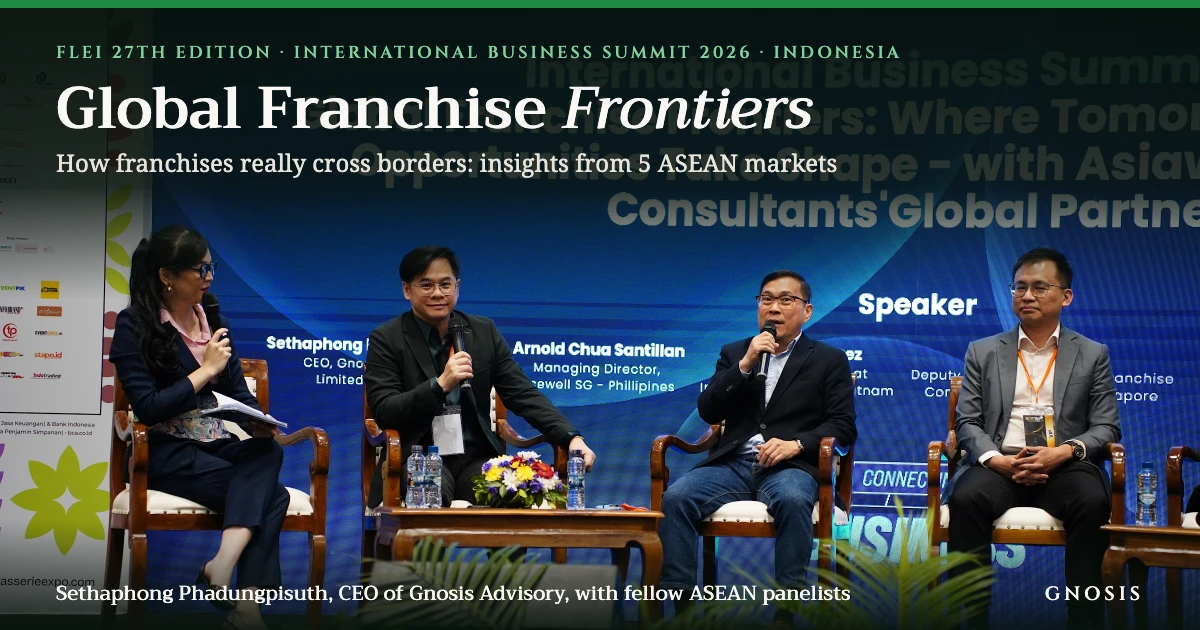
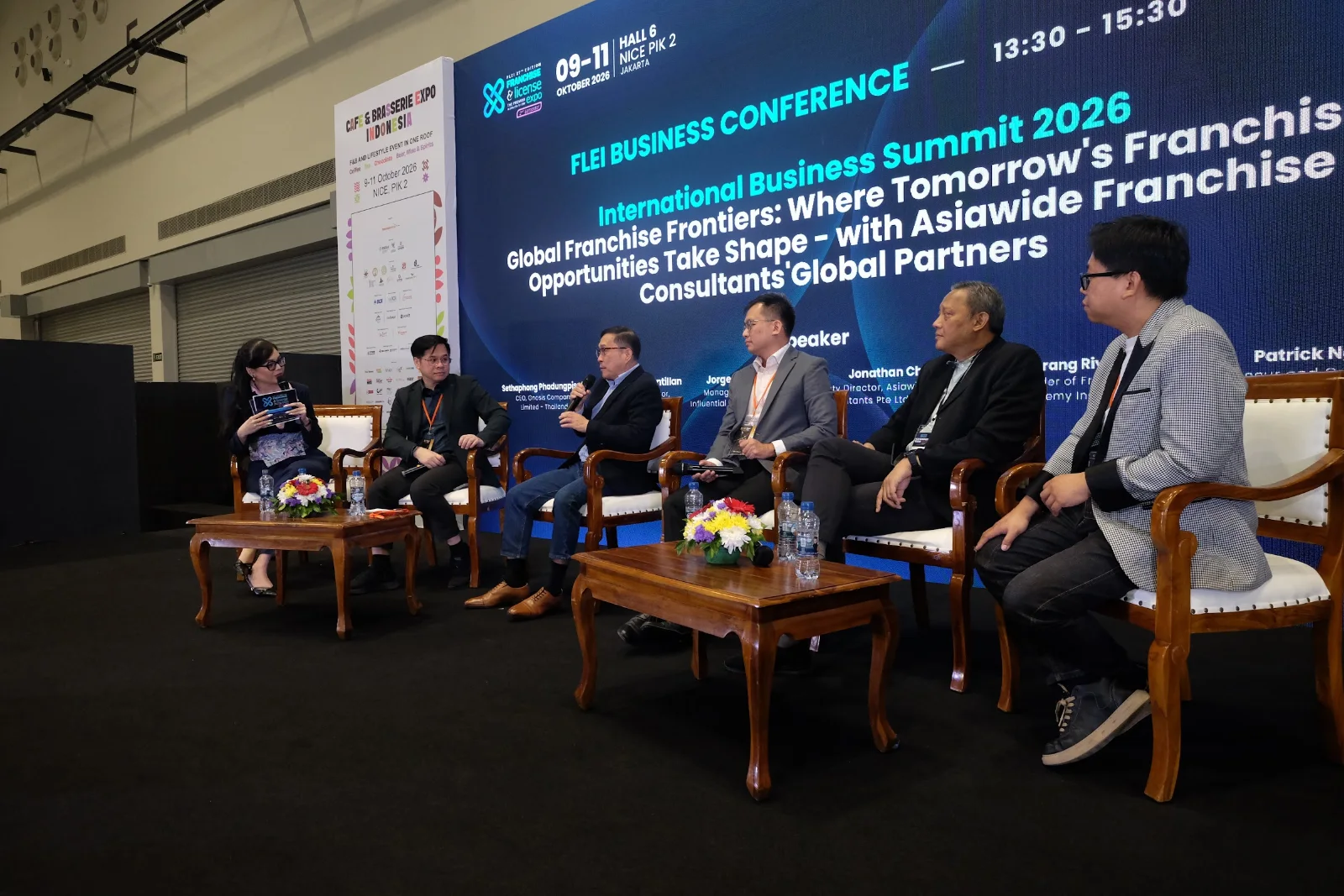
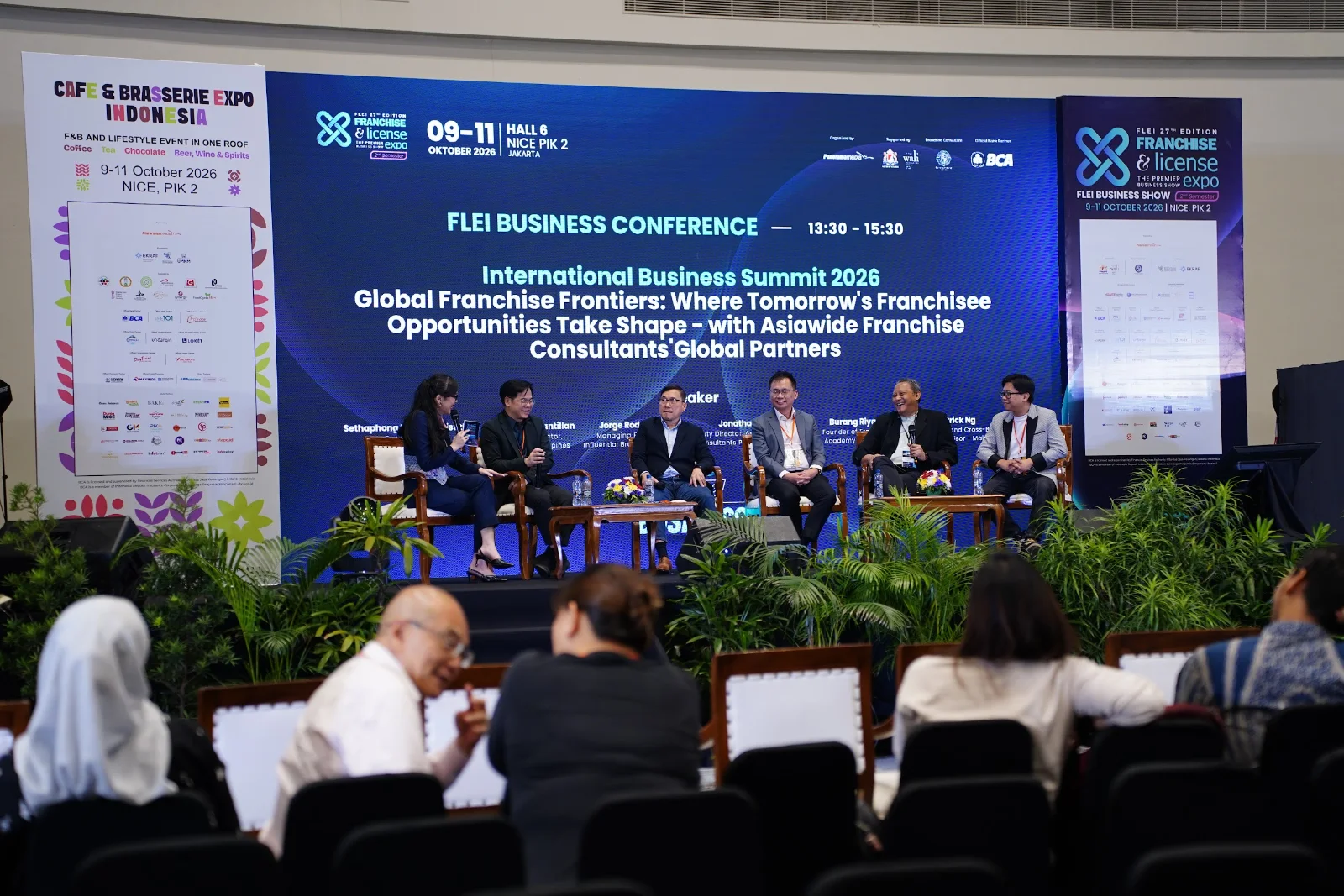
On 9 October 2026, Sethaphong “Seth” Phadungpisuth, CEO of Gnosis Advisory, represented Thailand on the panel of the International Business Summit 2026 at the 27th edition of FLEI, the Franchise & License Expo Indonesia. The session, titled “Global Franchise Frontiers: Where Tomorrow’s Franchisee Opportunities Take Shape”, was held with Asiawide Franchise Consultants’ global partners.
The summit took place at Nusantara International Convention Exhibition (NICE), PIK 2, Jl. M.H. Thamrin, Pantai Indah Kapuk 2, Salembaran, Kec. Kosambi, Kabupaten Tangerang, Banten 15214, in Greater Jakarta. For 90 minutes, five panelists walked the audience through what it really takes to move a franchise brand from one ASEAN market to another.1
Success at home
is not a passport abroad
Quick answer: what should a brand do before franchising abroad?
- Prove the system at home first. The panel suggested around 30 consistent outlets.
- Check the law and register trademarks early. In Thailand, registration can take 1–2 years.
- Plan for Halal, especially in Malaysia, where certification takes about 6–12 months.
- Fit the store format to local costs: small stores, kiosks or cloud kitchens.
- Build delivery app commissions of about 15–30% into the P&L from day one.
- Choose a well-funded local partner with real access to sites, not a quick deal.
Meet the panel
| Market | Speaker | Role |
|---|---|---|
| Thailand | Sethaphong Phadungpisuth | CEO, Gnosis Company Limited (Gnosis Advisory); Certified Franchise Executive (CFE) |
| Philippines | Arnold Chua Santillan | Managing Director, Risewell SG |
| Singapore | Jonathan Choy | Deputy Director, Asiawide Franchise Consultants Pte Ltd |
| Indonesia | Burang Riyadi | Founder, Franchise Academy Indonesia |
| Malaysia | Patrick Ng | Entrepreneur and Cross-Border Business Advisor |
The session was moderated by Sylvia Christina, and the summit opened with keynote remarks from Susan Su Shuang, Managing Director of Asiawide Franchise Consultants.
Thailand: no room in the middle
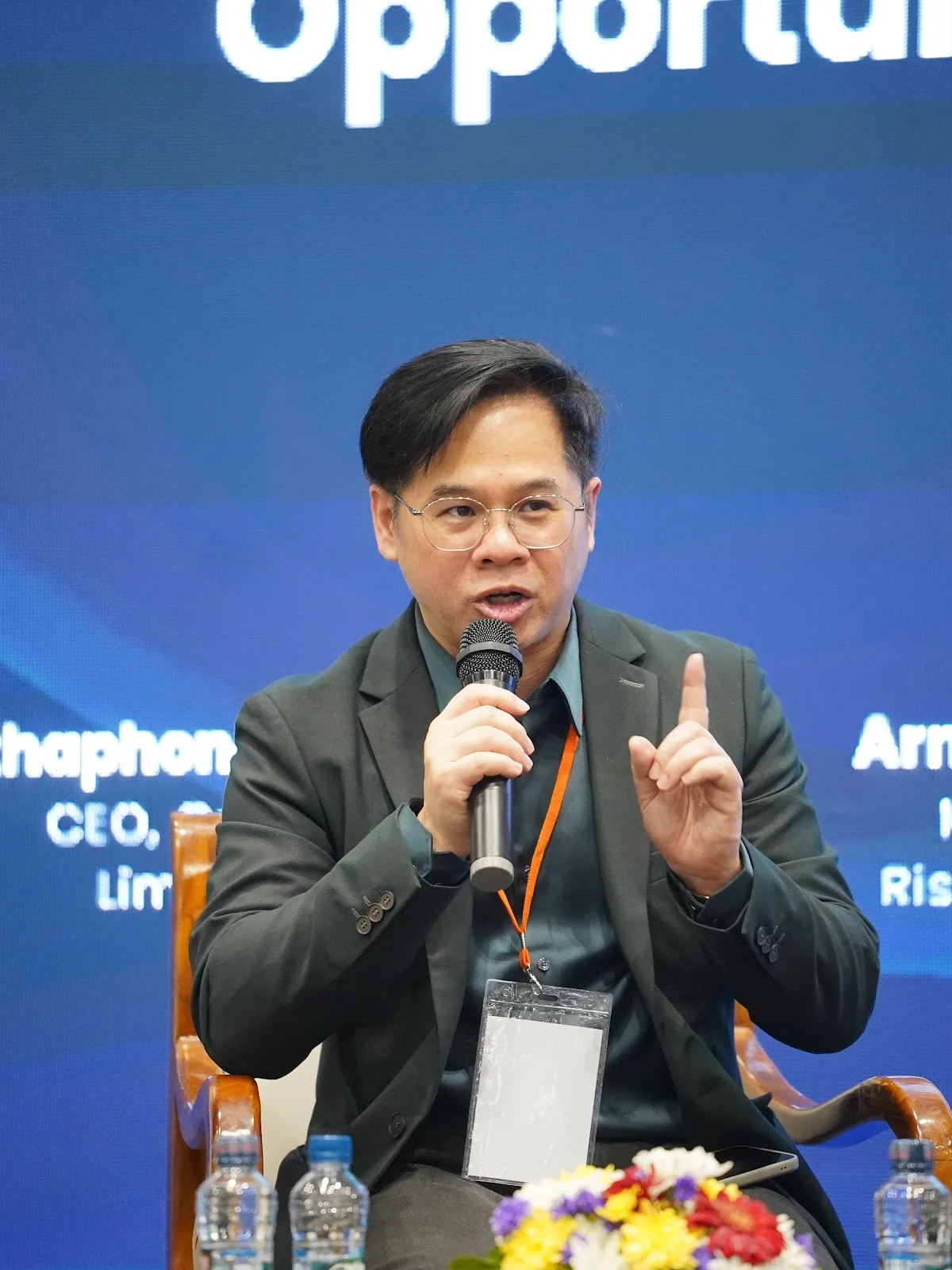
Thai consumers sit at two ends: authentic premium, or real value for money.
Seth explained that brands priced in the middle often struggle to survive. Foreign brands then face three hurdles before their first Thai outlet opens.
Law and trademarks. Thailand has no dedicated franchise law, so agreements fall under the Civil and Commercial Code. The Foreign Business Act restricts 100% foreign ownership of restaurant businesses, and trademark registration can take 1–2 years. File early.
Mall locations. Prime space sits largely with a few developers: Central Group, The Mall Group and Siam Piwat. Foreign brands win good sites through a well-connected local partner, or through social media buzz, such as viral TikTok queues that mall leasing teams look for.
Delivery apps. Line Man, Grab and Shopee dominate. With commissions of about 15–30%, delivery-heavy brands may do better starting with a cloud kitchen before opening a storefront.
The opportunity many miss: Halal. Thailand welcomes many Muslim tourists, but certified Halal dining is still in short supply. That gap is an opening for ASEAN Halal brands in Bangkok and tourist hubs.
Philippines: partner with a conglomerate
Arnold Chua Santillan, Managing Director of Risewell SG, said the key to the Philippines is a well-capitalized conglomerate partner. He contrasted two models: Alfamart, which scales store count quickly through a deep-pocketed partner, and J.CO Donuts, which partnered with Oishi and opens only in carefully chosen sites.
Failed entries, in his view, usually make three mistakes: not adapting flavors to local tastes, expanding before doing the research, and choosing a country for convenience rather than proven demand. The upside is strong domestic spending, supported by remittances and one of the world’s longest holiday shopping seasons.
Singapore: small and smart stores
Jonathan Choy, Deputy Director of Asiawide Franchise Consultants, described Singapore as the costliest market on the panel. Rents are high, and service businesses can hire foreign workers for only about 35% of their staff. Large, labor-heavy formats struggle; compact grab-and-go stores, self-order kiosks, cloud kitchens and automation work better. He pointed to Kopi Kenangan as an example of a lean, tech-driven store design.
Site selection must separate tourist and office corridors from residential HDB neighborhoods, where some outlets see up to 90% of sales from takeaway and delivery. His advice: visit in person rather than rely on numbers on paper.
Indonesia: build the system before you travel
Burang Riyadi, Founder of Franchise Academy Indonesia, stressed that a franchise grows abroad sustainably only with a strong back office: clear SOPs, a central training academy for franchisees, and monitoring for every outlet, even across borders. Smaller brands can test a new market with 1–2 joint-venture pilot outlets before signing a master franchise agreement. Franchising, he said, is shared value between partners, not short-term royalty collection.
Malaysia: Halal first, and don’t outrun your people
Patrick Ng, Entrepreneur and Cross-Border Business Advisor, advised brands to allow about 6–12 months for Halal certification in Malaysia. Even brands certified elsewhere often need to file again locally. He also warned that store count should never grow faster than the talent pipeline and supply chain can support.
Five markets at a glance
| Market | Main challenge | Halal | What to do |
|---|---|---|---|
| Thailand | Foreign ownership limits; 1–2 year trademark process; mall space held by a few developers | Undersupplied: an opportunity | Connected local partner, social buzz, consider a cloud kitchen |
| Philippines | Local flavor adaptation; need for a well-funded partner | Voluntary, widens reach | Partner with a conglomerate; choose volume or selective sites |
| Singapore | High rent; foreign worker cap of about 35% | Voluntary, widens reach | Small stores, kiosks, automation; tourist vs HDB sites |
| Indonesia | Consistent quality across borders | — | SOPs, training academy, outlet monitoring; 1–2 pilot outlets |
| Malaysia | Halal takes 6–12 months and often needs a local filing | Essential | Plan Halal first; grow at the pace of people and supply |
What every market has in common
Delivery apps squeeze margins. GrabFood, Line Man, ShopeeFood and Foodpanda charge about 15–30% commission, and delivery often eats into high-margin beverage sales.2 The panel recommended pricing app fees into the P&L from the start, promoting self-pickup, engineering the menu for delivery, and opening a local bank account for QR payments.
AI can help with site selection, but only with good data. During Q&A, a startup founder presented an AI site-evaluation tool. The panel agreed that location is the heart of F&B retail, and any tool must rely on hyper-local footfall and behavior data.
Small brands can start small. Asked how emerging brands should prepare, the panel pointed to clear SOPs, a monitoring system and 1–2 pilot outlets before full expansion.
Conclusion: slow and sure beats fast and retreat
The summit delivered one lesson from five markets. Expanding a franchise in ASEAN is not about copying a store; it is about getting four things ready:
- System: consistent outlets at home, with SOPs, training and quality monitoring.
- Law and licensing: register trademarks early, understand ownership rules and plan Halal in advance.
- Numbers: size the store to each market’s costs and price in delivery app fees from the start.
- Partner: choose someone with capital, site access and a long-term mindset.
For foreign brands entering Thailand, and Thai brands going abroad, Seth’s closing advice was simple: build long-term trust, keep partner relations transparent, and avoid unrealistic short-term payback expectations.

Frequently asked questions
How many outlets should a brand have before franchising abroad?
The Philippines panelist suggested around 30 domestic outlets to prove the system can be replicated.
Can a foreign company own 100% of a restaurant business in Thailand?
Generally, the Foreign Business Act restricts this. Most foreign brands enter through a master franchise or a Thai partner.
How long does Halal certification take in Malaysia?
About 6–12 months, and brands often need to file locally even with a foreign certificate.
What do food delivery apps charge in Southeast Asia?
About 15–30% commission, depending on the platform, the country and the package.
Why should Halal brands look at Thailand?
Thailand receives many Muslim tourists, but certified Halal dining options still fall short of demand.
- 1Speaker names and titles follow the official FLEI 27th Edition conference schedule. This article summarizes the discussion and is not a verbatim transcript. ↩
- 2Figures are indicative ranges shared during the session; actual commissions, timelines and rules vary by platform, market and over time. Photos were taken during the session on 9 October 2026. ↩
Sethaphong Phadungpisuth
CEO and Managing Director of Gnosis Advisory (Gnosis Company Limited), a Bangkok-based franchise and corporate finance advisory firm. Over 20 years in franchise system development, international business matching, business valuation and ASEAN market entry, with earlier roles at State Street Bank, Bangkok Bank and RSM Thailand.
M.S. International Business and Finance, Southern New Hampshire University · Certified Franchise Executive (CFE) · Director of International Affairs, Franchise and License Association of Thailand (FLAT) · Franchise Standards Evaluator, Department of Business Development (DBD)